 What’s real?
The sun shines, the clouds make rain, the wind blows. These things have created conditions that have made the whole of life on earth: soil, plants, forests, gazillions of organisms and creatures, spinning around on a little rock in space.
Do you remember the idea of economics as a closed system? The idea that you can only take out what you put it in? Do you remember I told you that there is enough? What about the idea that there is more than enough?
Guess what? The planet is not a closed system. Every day we receive more energy, more natural capital, than we need, not less. The sun throws 500 exajoules of energy at us every 90 minutes. That’s equivalent to our global energy consumption for an entire year. We just haven’t spent the time working out how to capture that energy yet. And that’s just solar energy.
Organic farming uses models to look at input and output. A ‘permaculture’ model, for example, is very different from an industrial farming model. Permaculture would look at a chicken and ask questions about its ‘needs’ (food, water, air, green ground to scratch in, warmth, shelter, safety, friends) and its ‘outputs’ (eggs, heat, manure, meat, feathers). It always looks at the needs first. And then it looks at how to maximise the outputs.
 The ‘chicken-greenhouse’ model in permaculture uses the heat from roosting chickens to keep a greenhouse warm at night. It also poses the question: What happens when you ignore the chicken’s needs? Battery chickens kept in indoor cages have outputs that include eggs and meat, but also disease, noise pollution (try living next door), heat (that requires energy-intensive air-conditioning), routine disposal of infected carcasses, routine anti-biotic use, and pain and misery. That’s very expensive.
How would we shape an economy based on human needs, first and foremost, before outputs?
So, permaculture also recognises that in its model of needs and outputs, everyday the sun ‘tops-up’ the system. We now have the technology to harness the natural energy of the sun, wind and waves, to have an ‘abundance’ of energy. You really have to look at the motives of ‘climate deniers’ (And windmill deniers! Why do people claim that ‘alternative’ energy doesn’t work, that windmills ‘spoil their view’? Is it not preferable to have a view?). The ‘price’ of creating energy through solar and wind-power is falling by the day and some countries are well on the way to providing all their energy needs with these energy sources that we call ‘renewables’ because they don’t run out. Scotland now produces enough renewable energy to power two Scotlands.
Can it be true that we can have abundance? That we are not really running out of the world’s resources? What about over population?
 The world’s population will decrease, not increase
We know that people in poverty have more children, because they have limited choice. There’s a big issue here about the inequality of women around the world, but we can summarise by saying: when people have enough food, education and options, they choose to have fewer children. The population of every continent is not increasing but has levelled off or is declining, except Africa, the poorest continent in the world.
If we truly care about overpopulation we should be throwing all our collective energy at getting Africa out of poverty, instead of installing an IMF-trained finance minister in every African country to prioritise the repayment of debt to the western finance industry.
With all our general anxiety about the planet’s future, many people are choosing to not have any children at all. This and other indicators suggest that world population will start to actually decrease.
 Inequality – the cause of all ills?
The African example leads us to a natural conclusion. If any of us are to survive on this planet, then we all must, or none of us will.
Inequality between rich and poor amongst people who live together in the same country leads to unhappiness and greed. The desire to ‘consume’ more, leads to unsustainable growth. Inequality between nations leads to unhappiness, unsustainable development, the depletion of natural resources and the loss of cultural identity as the poorer try to copy the ideals of the richer.
 The old models are broken
Old economic models of closed-system economics don’t work. The system was never ‘closed’ because it was always subsidised by ‘externalities’. ‘Growth’ of one nation was only possible at the expense of another. It was possible to believe that tree-felling without replanting was profitable, only because the true capital costs were never included. Natural resources were just systematically depleted. This deception could have continued unchecked but it has been brought to light as we realise we will run out of natural capital if we don’t change our behaviour. Now we see our oceans depleted of fish stocks, destruction of the rainforests that produce the planet’s oxygen, the threat to polar bears and penguins as the ice-caps melt, the loss of insects and small birds. It is said that if all the bees die out (and are no longer pollinating our food) humans will have about four years left on this planet. We have to do something about this. We can’t do nothing.
 Employment
In the Western world some of us work in farming or construction, but most of us work in the ‘service industry’, which is another way of saying that we don’t make anything. Increasingly our jobs will be done by computers and robots. So what will we do and will we still get paid? The idea of ‘full employment’ is already being questioned. Some countries are experimenting with the idea of a ‘Universal Basic Income’ (UBI), whereby everyone gets a regular sum of money from the state as a matter of right. If people work as well to earn more, that’s up to them. Pilot studies show that people are happier and actually more likely to work if you give them UBI than if they are in receipt of unemployment benefit, or no welfare benefits.
The idea of ‘earning’ your living is going to change. ‘Making’ money as a concept is on the way out. There’s still plenty of work to do. Gardens to plant, vegetables to grow, fences and roads to repair, children and old people to care for, paintings to make and books to write. Wars to stop. Poverty to fix. Wells to dig and irrigation systems to build. We could be so busy fixing things, making our world even more beautiful than it would be without us.
 Socialism
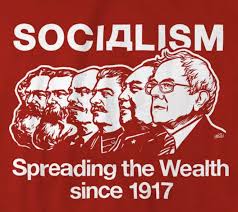
In the UK the government started to take action to improve public health in the mid 19th century. In the 20th century, before WW1, the foundations of the modern ‘Welfare State’ were laid with state pensions, maternity, disability and unemployment benefits, sick pay and free medical treatment. The government started building state-owned housing. ‘Municipal socialism’ brought gas, water, electricity, civil aviation, railways and coal-mining, as well as education and public health, out of the marketplace and into public ownership. The National Health Service came into being in the 1940s.
Scandinavian countries have championed ‘democratic socialism’ and provide the highest standards of living in the world. Communism in the Soviet Union and China took all industry as well as state infrastructure into public hands and, despite the best efforts of western propaganda, there is no evidence that communism has done a worse job than capitalism in providing for the health and wealth of its people, just take a look at China.
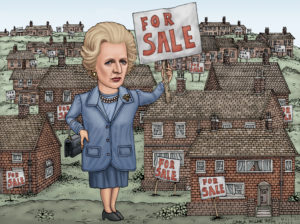 Thatcherism reversed the socialist trend and started to put public industry into private hands and privatisation became the ideology of the end of the 20thcentury.
We have started to realise that making profit out of public services to make entrepreneurs richer is inefficient. ‘Profits’ could be used to reinvest in those same public services. Cutting local bus services, for example, creates short-term savings but leads to loneliness amongst the elderly, which causes illness and increased health spending. But even more importantly, let us consider that thing economists call ‘externalities’.
If the private sector is making so-called ‘profit’ whilst the public sector (us, and our taxes) is paying to clean up the mess (pollution and poverty) caused by ‘externalities’, not properly accounted for, we have a problem. It literally means that the poor are subsidising the rich.
We are becoming aware of all this, the inequality, inefficiency and the social and environmental damage caused by capitalism as we know it today. We are starting to re-look at the wisdom of ‘the freedom of market forces’ (which, as we have seen are not ‘free’ anyway but heavily loaded in favour of western interests – particularly the US – and the interests of rich and powerful individuals).
The current enthusiasm for the Labour Party amongst UK young people is one recent phenomenon that demonstrates this growing understanding.
In the UK the Scottish Parliament proposes that public ownership of energy companies provides the best chance of making ‘externalities’ ‘inclusive’. If the clean-up costs, the real costs, of our energy consumption are managed by the same agency that provides the energy, we have the best chance of joined-up thinking about the real relationship between ‘price’ and ‘cost’.
 New models are needed
In creating new models, like the permaculture example, we need a new ‘standard’. Not gold, sterling, the dollar or the euro. For this reason we have started to consider ‘carbon’ cost, and our ‘carbon footprint’, the real and actual cost of the use of our common capital, with all the global costs and implications included, not dismissed as ‘externalities’.
With this realisation in mind, that at the moment private industry makes all the profit, whilst the costs of paying for the ‘externalities’ are paid by the public, through our taxes, and that we do the clean-up after the mess has been created, take a look at nuclear power.
The nuclear industry is the most extreme and appalling example of the dangers of calling real costs ‘externalities’. In the permaculture model the ‘output’ from a nuclear power station is 250,000 years of life-threatening pollution, (50 more years of a few people being able to plug-in their vacuum cleaner is a tiny bi-product, an insignificant blip). The inconceivable cost of nuclear, compared to the cheap abundance of renewables has led many people to question who is making a profit out of nuclear power stations? Or is it just that we need the nuclear ‘waste’ to make nuclear weapons?
So can we measure units of carbon cost? That’s like negative money, right? The sign of a successful person would be that you die having earned zero (Cost the planet nothing. Not robbed your grandchildren). Currency or ‘credit’ needs a new standard.
 Since 2008
There was a supposed ‘financial crash’ in 2008. The effect of buying and selling money came to a head. One ‘market trader’, Nick Leeson , moved virtual money from one virtual place to another – between so-called ‘shell’ companies – to fool shareholders that there was money when there wasn’t. So much imaginary money was involved that when his deception was discovered he brought about a near collapse of the entire global financial market.
One economy responded by cancelling debt to individuals and bringing legal action against the banks who were responsible, and that was Iceland. Interestingly, Iceland’s economy is doing very well right now. The other economies in the western world chose to do something different, instead giving lashings of virtual money to banks, so-called ‘quantitive easing’, for them to lend. This has allowed banks to continue with ‘business as usual’.
In the UK, the effect of privatising public housing (selling off ‘council houses’) has been a huge increase in the costs of accommodation, both in rent and house prices. Today 6% of housing is so-called ‘affordable’ (publically owned and housing association homes, which some would say is not actually ‘affordable’). In the 1970s nearly 40% of us lived in council houses and we had a ‘Fair Rent Tribunal’ to keep private rent reasonable too. Now, if you can’t pay up, you lose your home. Many modern mortgages are ‘designed to fail’ (the finance industry effectively taking bets – and making money – on how long it will take for borrowers to default).
In Britain, we have been removing the buffers that protect the poor and the vulnerable, like shelter, warmth and food. When our parents were young they would have been shocked and amazed to see homeless people on the streets. The recent cuts to social security benefits have led directly to deaths and suicides, and meant that people are prepared to work with no job security and for wages so low (in relation to living costs) that our grandparents would have found them unacceptable, in so-called modern civilized country.
In 2014 the Bank of England published a paper called ‘Money Creation in Western Economy’, publically admitting for the first time that money is credit, created by making loans. Politicians have been slower to confess to the truth, it has even been suggested that many of them don’t even realise it yet.
The ‘Strike Debt’ movement has been ‘buying up debt’ and then writing it off, to relieve individuals of the burden of interest payments. We spend between 25% and 50% of our incomes ‘servicing’ (paying interest on) debt. Jacinda Ardern, Prime Minister of New Zealand, has stated that capitalism has ‘failed our people’. Yannis Varoufakis says capitalism has ‘made itself obsolete’, and like many people, asks us to consider the role of artificial intelligence:
“Firstly the technologies were funded by some government grant; secondly every time you search for something on Google, you contribute to Google’s capital. And who gets the returns from capital? Google, not you. So now there is no doubt capital is being socially produced, and the returns are being privatised. This with artificial intelligence is going to be the end of capitalism.”
So if capitalism has failed, what shall we do next?
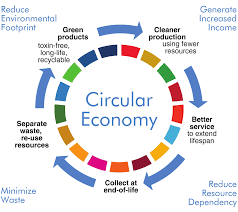 New Models – design them yourself
Remember we have more than enough, we have abundance. Or we should have.
Current forecasts for global warming are terrifying. But in 2017 India planted 66 million trees in 12 hours. It took 1.5 million volunteers. Ethiopia will plant 4bn trees over the summer of 2019. Recently, calculations suggest that ‘planting trees on 0.9 billion hectares of land could trap about two-thirds of the amount of carbon released by human activities since the start of the Industrial Revolution.’ The study that asserts this claim is based on how much tree-friendly land is globally available for use, without knocking down cities or taking over farms or natural grasslands. We have the means to fix the planet. What on earth are we waiting for?
 Kate Raworth has a good idea. She has created a new model for us that she calls ‘Doughnut Economics’. Think 2D doughnut, two concentric rings, a little one inside a big one. Outside the outer ring is environmental disaster, inside the inner ring is poverty and social depravity. Human activity needs to happen between the two rings (between the ‘ecological ceiling’ and the ‘social foundation’) in the ‘safe and just’ area. In other words, providing prosperity for all without polluting the planet should be our model, not ‘growth’.
Raworth says poverty and pollution are with us because we’re doing it wrong. It’s a design flaw on our part and we just need to improve our design. Her book, Doughnut Economics, Seven Ways to Think Like a 21st Century Economist, provides new models based on her experience as an economist and a senior researcher for Oxfam. The task now, she says is ‘to come up with economic designs that would enable nations coming towards the end of their GDP growth to learn to thrive without it.’
So, Come On! she says, Get Out Your Pencil!
 Regenerative Design
We don’t just have to settle for being ‘carbon-neutral’, or having ‘zero impact’, we can build cities and communities that are ‘climate-positive’. We can design models that make oxygen and drink pollution, feed plants and capture greenhouse gases.
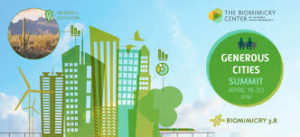
Janine Benyus uses biomimicry to design ‘generous cities’. She observes a city’s local natural ecosystem (such as the nearby forest or wetland) and then designs cities that recreate this standard with, for example, solar rooftops that grow food. The city is ‘generous’ because it contributes more than it consumes. Benyus says ‘Don’t ask: what’s my fair share to take. Ask: What other benefits can we layer in to this so that we can give some away’. This is Regenerative Design.
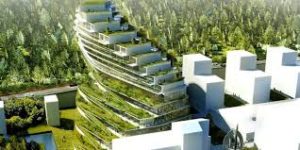 This is not just theory, it’s happening: In 2009 the town of Oberlin became one of America’s first climate-positive cities, currently absorbing more carbon dioxide than it produces, growing 70% of its food locally, preserving 20,000 acres of urban green space and reviving jobs, culture and community in what was previously a ‘rust-belt’ area of industrial decline. The project set up ‘Oberlin’s Environmental Dashboard’, a website which displays all of Oberlin’s vital statistics, from water consumption, oxygen levels in nearby Plum Creek, to carbon emissions per person, per hour, in real time.
 A resource-based economy
David Graeber notices that our financial history has seemed to follow 500 year patterns, alternating between credit and coin-based economies, making now the perfect time for the beginning of something new.
The Positive Money organisation suggests simple methods of spreading wealth about more evenly, by taxing financial transactions. Tom Picketty advises we tax capital.
There is the beginning of a new call for a ‘resource-based’ economy, with ‘currency’ linked to the actual value of stuff. If Varoufakis is right about capital being ‘socially produced’ then that’s you and me creating it, and we have power and responsibility. The New Economics Foundation is working for a ‘new model of wealth creation, based on equality, diversity and economic stability’, an economy where people are in control.
Local banking initiatives, credit unions and building societies allow us to keep any money we do have away from corporate bankers. Triodos Bank now offers a current account.
The ‘local’ thing is interesting. You can’t ignore ‘externalities’ if you can see stuff getting mined/produced and the resulting pollution all in the same place, in your own back yard. We increasingly want to be ‘in touch’ with what we eat and drink, preferring local farmers’ markets to supermarkets. The ‘Bristol Pound’ can only be traded in Bristol in the UK, intentionally keeping money away from multinational stores.
Yet at the same time our social media reach is planet-wide. We are now able to share information around the world, giving us power to sometimes effect change almost immediately (e.g. the Arab Spring), whereas previously all our information was filtered through the mainstream media. So we are local and global all at once.
 Community
We are increasingly aware that people need ‘community’. Feeling part of where we live and who we live with makes us happy. Feeling alienated from our surroundings and our neighbours makes us insecure and even antisocial. People who feel ‘safe’ behave more generously than people who don’t. The people who vote for immigration restrictions, for example, are often the poorest and most vulnerable, those who feel the most ‘unsafe’. The slogan ‘Think Global, Act Local’ is an attempt to describe the idea that you start to heal the world on your own doorstep first.
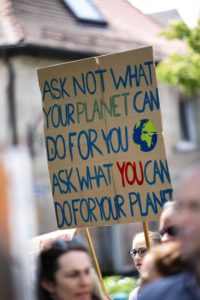 Think Bigger
But the idea that you and me have power and responsibility is exhausting. We can’t just do our little local bit and hope for the best. We can cycle to work and recycle everything, that won’t stop the greatest polluters, the oil and car industries. The extent of their contribution to pollution – compared to individuals – makes you want to chuck all your carefully washed jars straight into landfill.
So we have to get organised as well. Join your allotment society and do some guerrilla gardening, by all means, but also get politically active. Find a movement that inspires you and join in. Be inspired by the idea of ‘critical mass’. That’s the idea that it takes a small percentage of people behind an idea to get it to ‘tipping point’ (i.e. become mainstream). Studies suggest critical mass is somewhere between 10% and 15%.
Invent a new currency. Could we all just trade in plastic shopping trolley tokens? Probably, when we’ve used up all the oil, plastic will be more valuable than gold. Move your money to a local or ethical bank. See how much of your life you can live ‘money-free’.
Tell your work organisation that you want everyone’s salary to be disclosed to all staff. Why do we know everyone else’s pay grade, but not the earnings of the top managers? Tell them that pay transparency is good practice.
Take a look at our schools and universities and look at the subjects we are teaching. Are we teaching the right stuff? Is the subject content truthful and up to date?
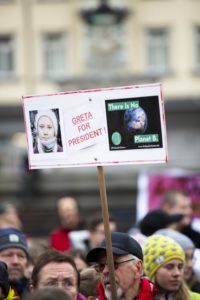 Remember that every progressive idea is started by a small number of people surrounded by others telling them that they are ‘not living in the real world’, and that ‘you can’t do anything to change it’.
Do the research. Read ‘Doughnut Economics’, not least because it’s full of examples of actually positive innovations and projects around the world. Ideas really are changing and so is economic thinking. Look up ‘Generous Cities’, the ‘Oberlin Project’, ‘Park 20/20’ in the Netherlands, ‘Newlight Technology’ in California, ‘Sundrop Farms’ in Australia, ‘Sanergy’ in Kenya. You will find some of them in Money Words and Ideas, on this site.
Read Donella Meadows, Barbara Ward, Katrine Marcal, Janine Benyus, Noam Chomsky, Nancy Folbre, Neva Goodwin, Ha-Joon Chang, Charles Eisenstein, Richard Titmuss, Jared Diamond, Elinor Ostrom, Marjorie Kelly, Mariana Mazzucato, John Fullerton, Yuan Yang, Bernard Leitaer, George Monbiot, Yanis Varoufakis, Alvin Toffler, EF Schumacher, Manfred Max-Neef, Hyman Minsky, Eric Beinhocker, Gar Alperovitz, Tod Johnson.
Be prepared for things to get rough. The people hanging on to their wealth are not going to give it up willingly. It has been suggested that social media has lowered the ‘tipping point’. Since the power of facebook, critical mass may be even less than 10%. No wonder powerful forces are trying to suppress the freedom of the internet.
Remember: There is enough. Actually, more-than-enough. Think about ecological thinking like permaculture and all that extra sun energy ‘topping up’ our ‘real’ economy, the economy of the living, breathing planet. Think Abundance. For all.
 To believe in the idea of ‘abundance’ is an act of rebellion in itself, because the opposite, poverty, keeps us all scared and behaving selfishly, keeps us voting for immigration restrictions and hard borders, keeps us grateful for zero hours contracts, stops us demanding more, better. So create abundance wherever you can. There’s that saying ‘If you are more fortunate than others, it’s better to build a longer table than a taller fence.’ Abundance means sharing, not hoarding. It means helping each other to feel safe.
‘Great’ civilizations have collapsed in the past, and greater equality has followed each time, because everyone loses. Each time, profound damage has been done to everyone, to society and to the environment. War puts nations into deep trauma from which it takes generations to recover, if ever. It hinders our development as a species and pollutes our lands. After a war, the poor people struggle in the rubble, whilst the rich retire to their private islands and get on their computers to bid for the contracts to rebuild, or renew the armaments, to be ready for the next war and so the cycle of smash-and-grab goes around. If we want to sort out our economy we should start by ending poverty and war as our first priority.
Colonialism (exploitation) and war has shaped our world. Yuval Noah Harari, in his book ‘Sapiens’, points out that we have arrived where we are by accident. That is, we have never decided how we want to develop, things just happened because a few people made random decisions about which most of us were mostly unaware, and one thing led to another.
That is no longer so. We are now aware of what’s going on in the world, moment by moment (and if you’re not then you’ve got your fingers in your ears and the duvet pulled over your head). For the first time in history, we have the opportunity to all decide how we want the human race to develop.
 At this unique moment we have another great power, the power to create life. Artificial Intelligence (AI) is with us now. We have already taught machines how to think for themselves and it is only a matter of time before they are better than us at thinking and doing almost everything and they will definitely be doing our jobs for us.
When we see a picture of a Syrian child fleeing a war zone, why do some of us feel deeply moved and want to help refugees, whilst other people simply want to build a taller fence? Yes, people lack compassion and generosity when they feel unsafe themselves, but the key word is ‘empathy’. Our great human strength is empathy. That, AI beings don’t yet have.
 Harari says we have finally become gods. That is, with our power to create life, we are just like those gods and goddesses on Mount Olympus. He recommends we use this opportunity to stop leaving our evolution to chance and decide how we want to live on this earth, because, he asks:
‘Is there anything more dangerous than dissatisfied and irresponsible gods who don’t know what they want?’
Poverty is not a lack of money, it is a design failure.
Change the world. It’s time. Good luck.
Next: Money Words and Ideas A-J